
Texas Roadhouse Nutrition Facts
Texas Roadhouse nutrition facts, from calories, protein, carbs, fat, sodium, fiber to sugar for every menu item, based on 2026 standardized data.
Nutrition data based on standardized recipes from Texas Roadhouse. Values may vary slightly as food is prepared fresh by hand. Source: texasroadhousnutritions.com — updated 2026.
What is the Texas Roadhouse Nutrition Table
We want to help you understand the texas roadhouse nutrition facts before you sit down to eat. Our texas roadhouse nutrition guide is a great way to see exactly what is in your food. On this page, we share the texas roadhouse nutrition table to give you accurate and complete information about your favorite menu items.
This is an interactive nutrition menu. It acts as one of our main nutrition tools. You can use these interactive tools to sort the food by clicking on the column headers.
We share this roadhouse nutrition data because every fans need a transparent menu and nutrition transparency info. The nutrition disclosure meets high restaurant nutrition and food labeling standards. This helpful nutrition label tool and nutrition calculator help customers and guests make informed decisions. When you have the knowledge of these numbers, you can easily see the nutritional value texas roadhouse offers.
Here is what you will find in our nutrition guide and texas roadhouse nutrition information layout:
Nutrition facts texas roadhouse fans look for, like calories.
Clear texas roadhouse nutritional information for every single dish.
Detailed texas roadhouse nutrition data to help you plan your next meal.
Easy-to-read nutrition details, including protein, fats, and carbs.
Use our nutrition facts and nutrition information to eat happy and stay healthy!
Texas Roadhouse Nutrition PDF
Sometimes, you want to take your health facts on the go. That is why we offer our texas roadhouse nutrition pdf. You can get this texas roadhouse nutrition information pdf directly from us. Some people search online for a texas roadhouse nutrition pdf free download or look on forums for a texas roadhouse nutrition pdf free download reddit link, but you can get it right here!
We also have the specific texas roadhouse rolls nutrition pdf for those famous, delicious rolls. We even compare it with the Texas corral nutrition information pdf so you can see the difference.
Our nutrition pdf is a complete nutrition guide. It lists every ingredient list for the menu items. As the returant serve scratch-made food that is made from scratch by hand, we use standardized recipes to keep the health information as precise as possible.
Here are a few quick things to know about our sheet:
Accurate information: We update our dietary information and nutrition disclosure regularly.
Complete information: This restaurant nutrition sheet covers all sides, main dishes, and appetizers.
Food safety standards: We follow FDA guidelines for food labeling and food safety. Calorie disclosure for chain restaurants is required under FDA menu labeling rules, which apply to all chains with 20 or more locations.
Please note the disclaimer: Since the meals are prepared by hand, small changes in portion sizes can happen.
Download Texas Roadhouse Nutrition PDF
Texas Roadhouse Nutrition Menu Table
This texas roadhouse nutrition menu is designed to make eating out simple. Below, you will see a detailed dropdown texas roadhouse menu nutrition chart. This nutrition menu shows you the texas roadhouse menu calories and full nutrient information for the entire texas roadhouse menu.
If you are looking for the texas roadhouse menu with prices and pictures, our interactive nutrition menu connects these details too. We show you the texas roadhouse menu items, including the lunch menu and the legendary steak menu.
Use the dropdown menu to check the calorie count and macronutrients for these popular menu items:
Steaks: The famous sirloin steak from the texas roadhouse steaks menu (also known as the texas roadhouse menu steaks).
Ribs: Enjoy a half or full slab of ribs.
Rolls & Butter: The sweet rolls served with warm cinnamon butter.
Sides: Tasty choices like crispy fries, a hot baked potato, or extra sauces.
Seafood & Chicken: Try the grilled salmon, chicken critters (our fried chicken strips), a grilled shrimp skewer, or a juicy grilled chicken breast.
You can easily sort our food options by clicking the column headers of our tables. We also offer a clear allergen menu and a gluten-friendly menu with many gluten-friendly options.
Let’s look at estimated calories for texas roadhouse and texas roadhouse calories in common portions:
| Item Name | Calories | Fat (g) | Sat Fat (g) | Cholesterol (mg) | Sodium (mg) | Carbs (g) | Fiber (g) | Sugars (g) | Protein (g) |
|---|---|---|---|---|---|---|---|---|---|
| Baked Potato Soup – Bowl | 380 | 25 | 12 | 50 | 910 | 27 | 2 | 4 | 9 |
| Baked Potato Soup – Cup | 220 | 15 | 7 | 30 | 530 | 16 | 1 | 2 | 5 |
| Boneless Buffalo Wings – Hot | 760 | 42 | 11 | 145 | 2130 | 37 | 12 | 2 | 60 |
| Boneless Buffalo Wings – Mild | 860 | 50 | 12 | 145 | 2830 | 43 | 5 | 1 | 58 |
| Cactus Blossom | 2250 | 135 | 26 | 15 | 5000 | 236 | 19 | 36 | 25 |
| Cheese Fries – Regular | 1240 | 65 | 25 | 110 | 5400 | 126 | 14 | 2 | 38 |
| Cheese Fries – Small | 860 | 44 | 17 | 70 | 3770 | 90 | 10 | 2 | 25 |
| Deviled Eggs | 520 | 40 | 10 | 710 | 750 | 12 | 0 | 7 | 27 |
| Firecracker Shrimp | 1080 | 88 | 14 | 185 | 1490 | 54 | 4 | 12 | 20 |
| Fried Pickles | 550 | 38 | 7 | 0 | 2580 | 48 | 5 | 1 | 6 |
| Grilled Shrimp (Starter) | 370 | 19 | 6 | 130 | 1740 | 29 | 1 | 4 | 20 |
| Killer Ribs | 910 | 53 | 18 | 175 | 2830 | 59 | 8 | 5 | 49 |
| Rattlesnake Bites | 560 | 36 | 19 | 80 | 1430 | 34 | 3 | 3 | 25 |
| Tater Skins | 1320 | 88 | 49 | 275 | 2470 | 63 | 7 | 5 | 63 |
| Texas Red Chili (no beans) – Bowl | 500 | 31 | 13 | 100 | 1460 | 23 | 5 | 8 | 33 |
| Texas Red Chili (no beans) – Cup | 250 | 15 | 5 | 50 | 800 | 13 | 3 | 4 | 17 |
| Texas Red Chili (with beans) – Bowl | 430 | 23 | 10 | 90 | 1180 | 25 | 6 | 5 | 31 |
| Texas Red Chili (with beans) – Cup | 210 | 10 | 4 | 45 | 640 | 14 | 4 | 3 | 16 |
| Twisted Mozzarella | 710 | 39 | 15 | 65 | 2610 | 64 | 4 | 6 | 27 |
| Fire Blossom | 2730 | 173 | 50 | 140 | 8730 | 248 | 22 | 43 | 49 |
| Item Name | Calories | Fat (g) | Sat Fat (g) | Cholesterol (mg) | Sodium (mg) | Carbs (g) | Fiber (g) | Sugars (g) | Protein (g) |
|---|---|---|---|---|---|---|---|---|---|
| Caesar Salad | 440 | 43 | 8 | 25 | 450 | 9 | 2 | 2 | 6 |
| California Chicken Salad | 970 | 46 | 19 | 240 | 2460 | 73 | 9 | 62 | 74 |
| Chicken Caesar Salad | 1100 | 89 | 16 | 205 | 1070 | 20 | 7 | 5 | 60 |
| Chicken Critter Salad | 690 | 40 | 17 | 355 | 1440 | 27 | 6 | 8 | 56 |
| Grilled Salmon Salad | 830 | 55 | 22 | 375 | 1310 | 19 | 6 | 9 | 66 |
| Grilled Shrimp Salad | 660 | 43 | 20 | 415 | 2130 | 20 | 5 | 9 | 52 |
| House Salad | 230 | 16 | 8 | 135 | 290 | 9 | 2 | 4 | 13 |
| Salmon Caesar Salad | 1110 | 99 | 17 | 120 | 1150 | 20 | 5 | 5 | 40 |
| Shrimp Caesar Salad | 940 | 78 | 16 | 155 | 1960 | 20 | 5 | 5 | 26 |
| Steakhouse Filet Salad | 1340 | 103 | 25 | 190 | 2870 | 42 | 8 | 21 | 71 |
| Item Name | Calories | Fat (g) | Sat Fat (g) | Cholesterol (mg) | Sodium (mg) | Carbs (g) | Fiber (g) | Sugars (g) | Protein (g) |
|---|---|---|---|---|---|---|---|---|---|
| Bone-In Ribeye | 1480 | 101 | 44 | 450 | 1720 | 20 | 4 | 4 | 143 |
| Dallas Filet – 6 oz. | 270 | 10 | 4 | 110 | 720 | 6 | 2 | 2 | 45 |
| Dallas Filet – 8 oz. | 360 | 13 | 6 | 145 | 960 | 8 | 2 | 2 | 60 |
| Filet Medallions | 760 | 30 | 10 | 170 | 2510 | 56 | 5 | 5 | 74 |
| Ft. Worth Ribeye – 12 oz. | 960 | 72 | 30 | 240 | 1180 | 12 | 4 | 2 | 78 |
| Ft. Worth Ribeye – 14 oz. | 1120 | 84 | 35 | 285 | 1370 | 14 | 4 | 2 | 90 |
| Ft. Worth Ribeye – 16 oz. | 1280 | 96 | 40 | 325 | 1570 | 16 | 5 | 3 | 103 |
| New York Strip – 8 oz. Thick Cut | 420 | 22 | 9 | 335 | 660 | 1 | 0 | 2 | 57 |
| New York Strip – 12 oz. Traditional Cut | 640 | 33 | 13 | 505 | 980 | 1 | 1 | 3 | 85 |
| New York Strip – 16 oz. Traditional Cut | 850 | 44 | 17 | 670 | 1310 | 2 | 2 | 3 | 114 |
| Porterhouse T-Bone | 1040 | 54 | 24 | 400 | 1440 | 1 | 2 | 4 | 139 |
| Prime Rib – 12 oz. | 950 | 72 | 31 | 260 | 1660 | 3 | 2 | 2 | 74 |
| Prime Rib – 14 oz. | 1110 | 84 | 37 | 305 | 1810 | 3 | 3 | 2 | 87 |
| Prime Rib – 16 oz. | 1260 | 95 | 42 | 345 | 1960 | 4 | 3 | 2 | 99 |
| USDA Choice Sirloin – 6 oz. | 250 | 6 | 2.5 | 125 | 560 | 3 | 1 | 1 | 46 |
| USDA Choice Sirloin – 8 oz. | 340 | 8 | 3 | 170 | 740 | 5 | 2 | 2 | 61 |
| USDA Choice Sirloin – 11 oz. | 460 | 11 | 4.5 | 235 | 1020 | 6 | 2 | 3 | 84 |
| USDA Choice Sirloin – 16 oz. | 670 | 16 | 6 | 340 | 1490 | 9 | 3 | 4 | 122 |
| Roadhouse Churrasco | 1000 | 62 | 18 | 165 | 2640 | 51 | 2 | 6 | 54 |
| Road Kill | 760 | 56 | 23 | 140 | 1420 | 10 | 3 | 4 | 55 |
| Steak Kabob | 920 | 41 | 11 | 145 | 2740 | 78 | 4 | 24 | 58 |
| Item Name | Calories | Fat (g) | Sat Fat (g) | Cholesterol (mg) | Sodium (mg) | Carbs (g) | Fiber (g) | Sugars (g) | Protein (g) |
|---|---|---|---|---|---|---|---|---|---|
| Fall-off-the-Bone Ribs – Full Slab | 1450 | 102 | 41 | 460 | 2260 | 15 | 4 | 10 | 116 |
| Fall-off-the-Bone Ribs – Half Slab | 900 | 63 | 25 | 285 | 1400 | 9 | 3 | 6 | 72 |
| Item Name | Calories | Fat (g) | Sat Fat (g) | Cholesterol (mg) | Sodium (mg) | Carbs (g) | Fiber (g) | Sugars (g) | Protein (g) |
|---|---|---|---|---|---|---|---|---|---|
| 6 oz. Sirloin & Grilled Shrimp | 670 | 30 | 10 | 260 | 2430 | 34 | 3 | 6 | 66 |
| 6 oz. Sirloin & Ribs | 800 | 45 | 18 | 300 | 1420 | 9 | 3 | 5 | 90 |
| 8 oz. Sirloin & Grilled Shrimp | 750 | 32 | 11 | 300 | 2610 | 35 | 3 | 6 | 81 |
| 8 oz. Sirloin & Ribs | 890 | 47 | 19 | 345 | 1600 | 10 | 3 | 6 | 105 |
| Dallas Filet & Grilled Shrimp | 680 | 33 | 12 | 240 | 2590 | 36 | 4 | 6 | 66 |
| Dallas Filet & Ribs | 820 | 49 | 20 | 285 | 1580 | 12 | 3 | 5 | 90 |
| Grilled BBQ Chicken & Ribs | 890 | 43 | 17 | 335 | 1450 | 34 | 4 | 25 | 91 |
| Grilled BBQ Chicken & Sirloin | 590 | 10 | 3.5 | 285 | 1150 | 31 | 3 | 23 | 92 |
| 8 oz Strip & Grilled Shrimp | 840 | 46 | 16 | 470 | 2530 | 31 | 3 | 6 | 77 |
| 8 oz Strip & Ribs | 980 | 61 | 24 | 510 | 1520 | 7 | 2 | 6 | 101 |
| 12 oz Ft. Worth Ribeye & Grilled Shrimp | 1370 | 96 | 38 | 375 | 3050 | 42 | 5 | 7 | 98 |
| 12 oz Ft. Worth Ribeye & Ribs | 1510 | 111 | 46 | 420 | 2040 | 18 | 5 | 6 | 122 |
| Chicken Critters & Ribs | 820 | 51 | 18 | 250 | 1540 | 21 | 3 | 5 | 70 |
| Chicken Critters & Sirloin | 520 | 18 | 5 | 200 | 1240 | 19 | 3 | 2 | 72 |
| Item Name | Calories | Fat (g) | Sat Fat (g) | Cholesterol (mg) | Sodium (mg) | Carbs (g) | Fiber (g) | Sugars (g) | Protein (g) |
|---|---|---|---|---|---|---|---|---|---|
| California Chicken Dinner | 490 | 21 | 7 | 185 | 970 | 25 | 5 | 20 | 55 |
| Chicken Critters | 480 | 21 | 4 | 130 | 1190 | 26 | 3 | 2 | 45 |
| Country Fried Chicken | 770 | 44 | 16 | 180 | 1460 | 45 | 1 | 9 | 48 |
| Grilled BBQ Chicken | 300 | 3.5 | 1 | 160 | 450 | 19 | 2 | 15 | 46 |
| Herb Crusted Chicken | 260 | 4 | 1 | 160 | 1210 | 12 | 4 | 8 | 47 |
| Smothered Chicken with Cream Gravy | 330 | 12 | 3.5 | 160 | 600 | 8 | 3 | 4 | 48 |
| Smothered Chicken with Jack Cheese | 430 | 20 | 8 | 185 | 780 | 8 | 3 | 4 | 55 |
| Chicken Parm Penne | 1300 | 52 | 20 | 190 | 2870 | 123 | 11 | 14 | 81 |
| Green Chile Chicken | 480 | 13 | 6 | 200 | 800 | 19 | 6 | 12 | 61 |
| Portobello Mushroom Chicken | 430 | 20 | 9 | 190 | 1030 | 7 | 3 | 2 | 58 |
| San Antonio Chicken Entree | 1030 | 48 | 19 | 230 | 3610 | 78 | 9 | 10 | 71 |
| Sierra Chicken Pasta | 1200 | 65 | 33 | 255 | 2220 | 85 | 6 | 6 | 68 |
| Item Name | Calories | Fat (g) | Sat Fat (g) | Cholesterol (mg) | Sodium (mg) | Carbs (g) | Fiber (g) | Sugars (g) | Protein (g) |
|---|---|---|---|---|---|---|---|---|---|
| Beef Tips with Mashed Potatoes | 960 | 58 | 19 | 175 | 3300 | 48 | 6 | 12 | 61 |
| Beef Tips with Seasoned Rice | 1060 | 57 | 16 | 170 | 4400 | 71 | 5 | 12 | 63 |
| Bone-In Pork Chop | 920 | 61 | 14 | 250 | 2880 | 6 | 0 | 5 | 86 |
| Country Fried Sirloin | 1170 | 75 | 22 | 205 | 2220 | 72 | 2 | 9 | 52 |
| Grilled Pork Chops – Single Chop | 440 | 26 | 9 | 945 | 2430 | 10 | 2 | 2 | 42 |
| Grilled Pork Chops – Double Chop | 730 | 38 | 13 | 1885 | 4060 | 13 | 3 | 2 | 82 |
| Pulled Pork Dinner | 890 | 41 | 14 | 270 | 1130 | 54 | 4 | 23 | 80 |
| Item Name | Calories | Fat (g) | Sat Fat (g) | Cholesterol (mg) | Sodium (mg) | Carbs (g) | Fiber (g) | Sugars (g) | Protein (g) |
|---|---|---|---|---|---|---|---|---|---|
| Fried Catfish – 3 Piece | 990 | 82 | 13 | 125 | 1230 | 35 | 0 | 0 | 30 |
| Fried Catfish – 4 Piece | 1170 | 93 | 15 | 160 | 1490 | 45 | 1 | 1 | 40 |
| Grilled Salmon – 5 oz. | 410 | 33 | 8 | 75 | 770 | 2 | 0 | 0 | 27 |
| Grilled Salmon – 8 oz. | 560 | 42 | 10 | 120 | 950 | 2 | 0 | 0 | 45 |
| Grilled Shrimp Dinner (9 Shrimp) | 660 | 37 | 10 | 200 | 3880 | 50 | 3 | 4 | 29 |
| Grilled Shrimp Dinner (10 Shrimp) | 670 | 37 | 10 | 225 | 4090 | 50 | 3 | 4 | 32 |
| Grilled Shrimp Dinner (12 Shrimp) | 700 | 38 | 11 | 270 | 4520 | 50 | 3 | 4 | 37 |
| Fish & Chips | 790 | 38 | 7 | 120 | 3020 | 71 | 8 | 2 | 42 |
| Item Name | Calories | Fat (g) | Sat Fat (g) | Cholesterol (mg) | Sodium (mg) | Carbs (g) | Fiber (g) | Sugars (g) | Protein (g) |
|---|---|---|---|---|---|---|---|---|---|
| All-Beef Hot Dog | 390 | 23 | 10 | 50 | 1010 | 27 | 0 | 4 | 14 |
| Jr. Chicken Tenders | 360 | 16 | 3 | 70 | 780 | 24 | 2 | 0 | 31 |
| Kid's Grilled Chicken | 110 | 2 | 0.5 | 80 | 90 | 0 | 0 | 0 | 23 |
| Lil' Dillo Steak Bites | 170 | 4 | 1.5 | 85 | 370 | 2 | 0 | 0 | 31 |
| Mac and Cheese (Kids) | 380 | 18 | 11 | 55 | 450 | 37 | 2 | 2 | 17 |
| Mini-Cheeseburgers | 670 | 36 | 15 | 60 | 950 | 57 | 3 | 9 | 30 |
| Ranger Meal – Andy's Steak | 250 | 6 | 2.5 | 125 | 560 | 3 | 1 | 1 | 46 |
| Ranger Meal – Chicken Critters Basket | 340 | 15 | 3 | 95 | 850 | 19 | 2 | 1 | 32 |
| Ranger Meal – Ranger Rib Basket | 550 | 39 | 15 | 175 | 860 | 6 | 2 | 4 | 44 |
| Item Name | Calories | Fat (g) | Sat Fat (g) | Cholesterol (mg) | Sodium (mg) | Carbs (g) | Fiber (g) | Sugars (g) | Protein (g) |
|---|---|---|---|---|---|---|---|---|---|
| All-American Cheeseburger | 880 | 55 | 22 | 125 | 1970 | 48 | 5 | 11 | 50 |
| Bacon Cheeseburger | 980 | 62 | 24 | 150 | 2410 | 48 | 5 | 12 | 59 |
| BBQ Chicken Sandwich | 640 | 18 | 5 | 165 | 1310 | 63 | 6 | 24 | 55 |
| Grilled Chicken Sandwich | 560 | 18 | 5 | 165 | 1040 | 45 | 6 | 10 | 55 |
| Mushroom Jack Chicken Sandwich | 710 | 30 | 11 | 190 | 1410 | 48 | 6 | 11 | 63 |
| Pulled Pork Sandwich | 870 | 40 | 13 | 220 | 1220 | 62 | 4 | 22 | 68 |
| Smokehouse Burger | 1080 | 67 | 28 | 150 | 2490 | 60 | 6 | 20 | 58 |
| Fried Chicken Sandwich | 830 | 37 | 9 | 135 | 1760 | 72 | 4 | 10 | 50 |
| Country Fried Pork Sandwich (Indiana) | 1040 | 73 | 14 | 90 | 1800 | 59 | 4 | 10 | 39 |
| Country Fried Pork Sandwich (Iowa) | 620 | 28 | 8 | 70 | 1490 | 53 | 4 | 9 | 39 |
| Item Name | Calories | Fat (g) | Sat Fat (g) | Cholesterol (mg) | Sodium (mg) | Carbs (g) | Fiber (g) | Sugars (g) | Protein (g) |
|---|---|---|---|---|---|---|---|---|---|
| Applesauce | 110 | 0 | 0 | 0 | 15 | 28 | 3 | 23 | 0 |
| Baked Potato | 380 | 13 | 5 | 10 | 1950 | 60 | 6 | 3 | 7 |
| Buttered Corn | 190 | 9 | 2.5 | 0 | 550 | 29 | 3 | 6 | 5 |
| Caesar Side Salad | 440 | 43 | 8 | 25 | 450 | 9 | 2 | 2 | 6 |
| Fresh Vegetables | 190 | 15 | 4.5 | 0 | 480 | 13 | 5 | 4 | 3 |
| Green Beans | 100 | 3.5 | 1 | 10 | 1070 | 13 | 2 | 4 | 6 |
| House Side Salad | 230 | 16 | 8 | 135 | 290 | 9 | 2 | 4 | 13 |
| Mac and Cheese | 380 | 18 | 11 | 55 | 450 | 37 | 2 | 2 | 17 |
| Mashed Potatoes | 260 | 17 | 6 | 10 | 330 | 24 | 2 | 2 | 3 |
| Seasoned Rice | 360 | 15 | 3.5 | 0 | 1430 | 47 | 2 | 3 | 6 |
| Steak Fries | 360 | 14 | 2.5 | 0 | 1970 | 53 | 6 | 0 | 5 |
| Sweet Potato | 350 | 9 | 3.5 | 5 | 105 | 62 | 10 | 19 | 6 |
| Charred Jalapeños | 50 | 4.5 | 0.5 | 0 | 720 | 3 | 1 | 2 | 0 |
| Fresh-Baked Bread | 200 | 8 | 3 | 0 | 200 | 28 | 1 | 4 | 5 |
| Sautéed Mushrooms | 120 | 11 | 3 | 0 | 480 | 5 | 2 | 2 | 3 |
| Sautéed Onions | 150 | 10 | 2 | 0 | 570 | 13 | 2 | 6 | 2 |
| Steamed Broccoli | 210 | 16 | 5 | 0 | 490 | 17 | 8 | 3 | 5 |
| Item Name | Calories | Fat (g) | Sat Fat (g) | Cholesterol (mg) | Sodium (mg) | Carbs (g) | Fiber (g) | Sugars (g) | Protein (g) |
|---|---|---|---|---|---|---|---|---|---|
| Bacon (2 slices) | 100 | 7 | 2.5 | 25 | 440 | 0 | 0 | 0 | 9 |
| Bleu Cheese Dressing (3 oz) | 430 | 45 | 7 | 25 | 600 | 5 | 0 | 1 | 3 |
| Caesar Dressing (3 oz) | 540 | 56 | 9 | 30 | 500 | 6 | 0 | 1 | 4 |
| Cheddar Cheese (1 oz) | 110 | 9 | 6 | 30 | 170 | 0 | 0 | 0 | 7 |
| Honey Mustard Dressing (3 oz) | 480 | 48 | 7 | 20 | 420 | 16 | 0 | 11 | 0 |
| Italian Dressing (3 oz) | 410 | 36 | 5 | 0 | 640 | 17 | 0 | 16 | 0 |
| Ranch Dressing (3 oz) | 430 | 47 | 6 | 20 | 520 | 5 | 0 | 1 | 0 |
| Sour Cream (2 tbsp) | 40 | 3.5 | 2.5 | 15 | 10 | 0 | 0 | 0 | 0 |
| Texas Roadhouse Barbecue Sauce (3 oz) | 120 | 0 | 0 | 0 | 410 | 27 | 0 | 21 | 0 |
| Whipped Butter (1 tbsp) | 90 | 10 | 3 | 0 | 120 | 0 | 0 | 0 | 0 |
| Item Name | Calories | Fat (g) | Sat Fat (g) | Cholesterol (mg) | Sodium (mg) | Carbs (g) | Fiber (g) | Sugars (g) | Protein (g) |
|---|---|---|---|---|---|---|---|---|---|
| Big Ol' Brownie | 1200 | 40 | 24 | 100 | 740 | 203 | 8 | 151 | 12 |
| Granny's Apple Classic | 1110 | 50 | 16 | 75 | 970 | 161 | 2 | 97 | 9 |
| Strawberry Cheesecake | 800 | 47 | 26 | 135 | 550 | 76 | 3 | 60 | 10 |
| Bread Pudding | 1390 | 53 | 27 | 270 | 830 | 204 | 4 | 135 | 26 |
| Item Name | Calories | Fat (g) | Sat Fat (g) | Cholesterol (mg) | Sodium (mg) | Carbs (g) | Fiber (g) | Sugars (g) | Protein (g) |
|---|---|---|---|---|---|---|---|---|---|
| Coca-Cola (20 oz) | 240 | 0 | 0 | 0 | 75 | 65 | 0 | 0 | 0 |
| Diet Coke (20 oz) | 0 | 0 | 0 | 0 | 75 | 0 | 0 | 0 | 0 |
| Dr Pepper | 130 | 0 | 0 | 0 | 50 | 33 | 0 | 32 | 0 |
| Sprite | 120 | 0 | 0 | 0 | 30 | 31 | 0 | 31 | 0 |
| Root Beer (20 oz) | 280 | 0 | 0 | 0 | 75 | 74 | 0 | 0 | 0 |
| Lemonade (20 oz) | 260 | 0 | 0 | 0 | 25 | 66 | 0 | 0 | 0 |
| Minute Maid Lemonade | 130 | 0 | 0 | 0 | 90 | 36 | 0 | 34 | 0 |
| Blue Crush Lemonade | 150 | 0 | 0 | 0 | 30 | 40 | 0 | 38 | 0 |
| Red Raspberry Lemonade | 150 | 0 | 0 | 0 | 30 | 40 | 0 | 37 | 0 |
| Wild Strawberry Lemonade | 150 | 0 | 0 | 0 | 30 | 40 | 0 | 38 | 0 |
| Iced Tea – Unsweetened (20 oz) | 5 | 0 | 0 | 0 | 10 | 1 | 0 | 0 | 0 |
| Iced Tea – Original Sweet | 110 | 0 | 0 | 0 | 5 | 28 | 0 | 27 | 0 |
| Iced Tea – Peach Sweet | 140 | 0 | 0 | 0 | 20 | 35 | 0 | 34 | 0 |
| Iced Tea – Peach Unsweet | 45 | 0 | 0 | 0 | 20 | 11 | 0 | 10 | 0 |
| Iced Tea – Raspberry Sweet | 130 | 0 | 0 | 0 | 5 | 35 | 0 | 33 | 0 |
| Iced Tea – Raspberry Unsweet | 40 | 0 | 0 | 0 | 10 | 10 | 0 | 9 | 0 |
| Juice – Apple | 80 | 0 | 0 | 0 | 15 | 21 | 0 | 19 | 0 |
| Juice – Orange | 90 | 0 | 0 | 0 | 15 | 20 | 0 | 18 | 1 |
| Milk (2%, 8 oz) | 120 | 5 | 1.5 | 10 | 100 | 12 | 0 | 10 | 8 |
| Coffee – Regular | 5 | 0 | 0 | 0 | 0 | 1 | 0 | 0 | 0 |
| Coffee – Decaffeinated | 5 | 0 | 0 | 0 | 0 | 1 | 0 | 0 | 0 |
| Water (Bottled, 16.9 oz) | 0 | 0 | 0 | 0 | 0 | 0 | 0 | 0 | 0 |
Difference Between Texas Roadhouse Nutrition Facts Table and Calculator
We want to explain the difference between our two main interactive tools: the nutrition table and the Texas roadhouse nutrition calculator. Both tools give you valuable texas roadhouse nutrition facts and key nutrition info for texas roadhouse, but they work in different ways.
Let’s compare them:
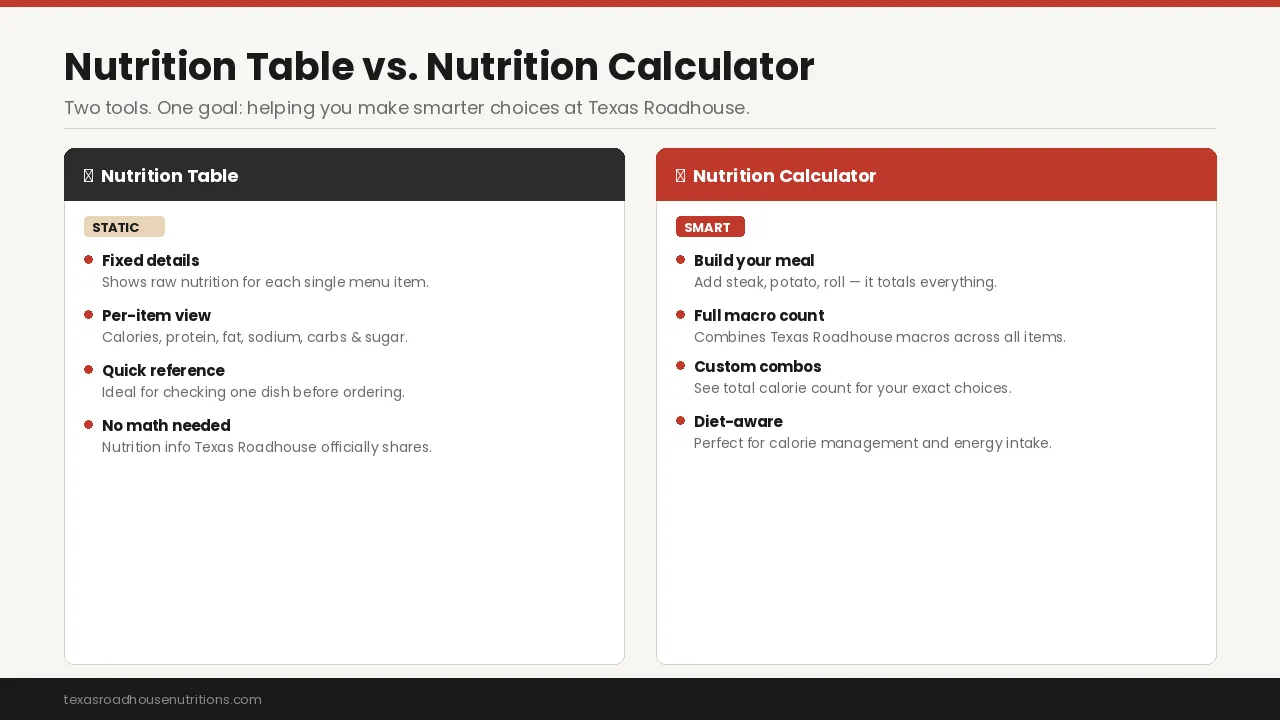
The Nutrition Table: This tool displays the fixed nutrition details for each single item on the menu. It is like a static interactive nutrition menu where you see the texas roadhouse nutrition info and general nutritional info texas roadhouse shares. It lists the raw numbers for calories, protein, fat, sodium, carbs (or carbohydrates), and sugar.
The Nutrition Calculator: This smart nutrition calculator lets you build a full meal! It adds up all the texas roadhouse macros and the total calorie count for your custom meal choices. If you add a steak, a baked potato, and a roll, the tool combines their nutrition data to show your total energy intake.
Both tools are excellent for meal planning, diet tracking, and tracking calories. They help you manage your daily calorie intake and fit your calorie intake goals easily.
What Texas Roadhouse Nutrition Facts Page Covers
This page is the ultimate guide to the nutrition facts texas roadhouse guests need. It covers everything you want to know about the menu items. We provide complete nutritional information and nutrient information using our easy nutrition tools.
Here is a breakdown of what our page covers:
Sodium and Drinks: We list the exact Texas roadhouse nutrition facts sodium levels. We even show details like the Porch rocker texas roadhouse nutrition facts for our drink fans.
The Rolls: We have a dedicated Texas roadhouse rolls nutrition pdf. It explains the texas roadhouse roll calories, the general texas roadhouse rolls calories.
Allergen Disclosure and Food Safety:
We share full allergen information and an allergen menu to assist guests with a food allergy or other dietary restrictions.
We detail common allergens, identifying each major food allergen in our ingredients.
We explain the use of soybean oil, specifically refined soybean oil. This cooking oil consists of refined oils or highly refined oils, which are generally safer, but we still make a full allergen disclosure.
We warn about cross-contact and cross-contamination. Since they have shared cooking areas and busy preparation areas, they use strict kitchen precautions, food safety standards, food handling, and food preparation steps to prevent cross-contact.
However, they cannot guarantee any meal is 100% allergen free of all allergens.
They take food safety and dietary accommodations seriously to meet the dietary needs of the customers and guests. Please read the FDA-aligned disclaimer on the page for complete safety details.
Why You Should Know Nutrition Facts of Texas Roadhouse Menu Items
Why should you care about texas roadhouse nutrition? When you visit the resturant, we want you to enjoy the legendary food and legendary service while staying on track with your health. Knowing the nutrition information we offers helps you make informed decisions for all your dining decisions.
Understanding the texas roadhouse calories is great for your lifestyle. Whether your health goals focus on weight loss, muscle gain, maintenance, or muscle recovery, the knowledge of these numbers is power.
Here is why keeping an eye on texas roadhouse restaurant nutrition helps:
Avoid Hidden Elements: It is easy to overlook hidden sugar, hidden fat, or hidden sodium in restaurant meals.
Manage Your Day: Knowing the calorie count helps you stay within your daily calorie intake or daily intake goals.
Enjoy Guilt-Free Eating: You can plan your energy intake so you can enjoy the comfort foods, hearty sides, buttery rolls, and juicy steaks without regret.
We believe in mindful eating, eating clean, and healthy eating, even when dining out. We want you to have access to the best dietary and health information to support a balanced and active diet.
How to Use Nutrition Data for Better Meal Planning
Planning your meal does not mean losing out on flavor. By using our texas roadhouse nutrition data and the nutrition calculator, you can master meal planning and diet tracking. Having the right nutrition information makes eating well simple.
Here are some easy nutrition tips and healthy swaps to use the next time you look at our texas roadhouse nutrition information:
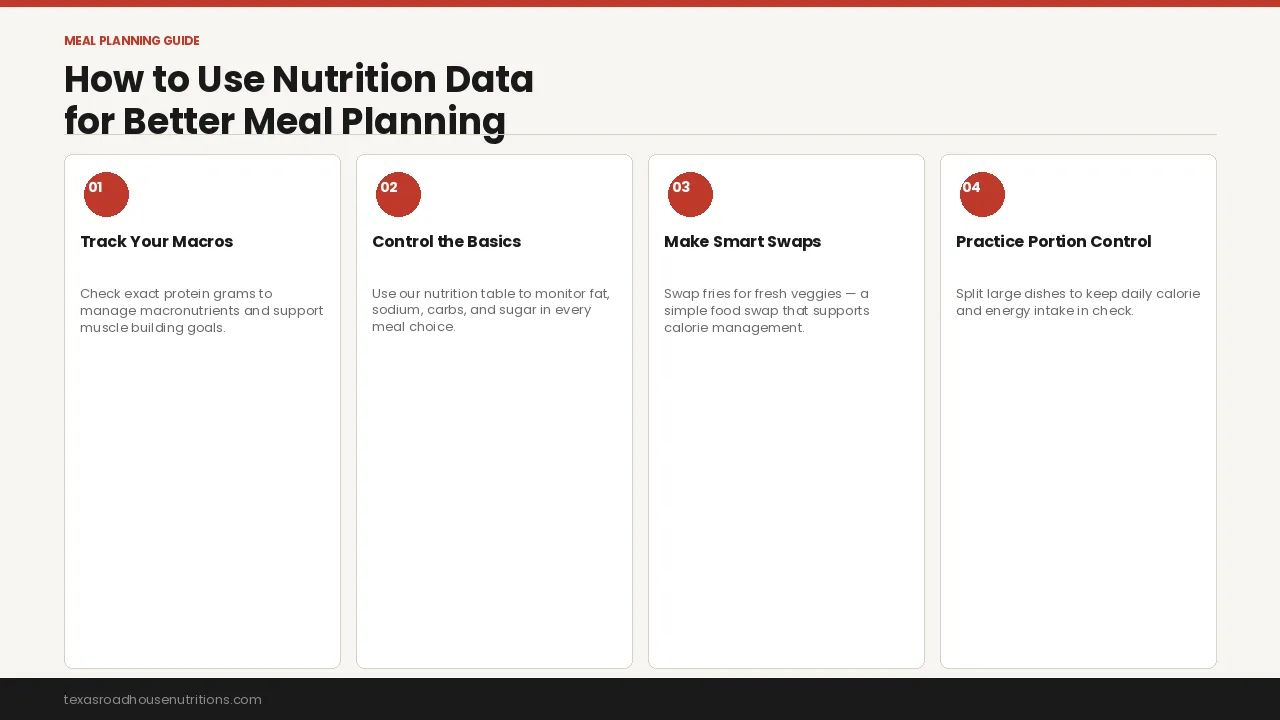
Track Your Macros: Look at the texas roadhouse macros to manage your macronutrients. You can see the exact gram protein count if you are building muscle.
Control the Basics: Use our nutrition table and nutrition guide to check the fat content, sodium, carbs, and sugar in your meal choices.
Make Smart Swaps: Use food swaps (like swapping fries for fresh veggies) as part of your calorie management and dietary choices.
Practice Portion Control: If you want to keep your calorie intake, daily calorie intake, and overall energy intake low, try splitting large dishes.
Our interactive tools and interactive nutrition menu make it easy to find the exact calorie count and nutrition details for all your food choices. Making better choices and smart swaps helps you enjoy a balanced diet without any regrets!
Nutrition Facts for Special Diets
We want everyone to enjoy a great meal, no matter their dietary needs or dietary restrictions. Texas roadhouse offer helpful dietary information for several special diets. Since they make scratch-made food that is made from scratch using standardized recipes, you can easily trust our texas roadhouse nutrition info.
Let’s explore options for different diets based on the nutritional value texas roadhouse offers:
Low-Carb and Keto: If you are on a keto diet or a low-carb diet, we have great low-carb picks. Stick to high-protein meats like a ribeye or a juicy sirloin steak. Watch the texas roadhouse sirloin nutrition to keep your carbs (or carbohydrates) and sugar low. Ask for your steak without extra sauce.
High-Protein: For high-protein meals, choose the grilled chicken breast or a grilled shrimp skewer. These are packed with protein while keeping fat, sodium, and calories in a healthy range. You can also add protein-rich toppers like bacon or an egg. According to the Dietary Guidelines for Americans, adults are advised to keep sodium under 2,300mg and total daily calories around 2,000
Vegetarian: While they are famous for steaks, they still offer vegetarian-friendly options. You can order a baked potato (loaded or plain), extra veggies, or a fresh house salad. Be sure to request a light dressing or your favorite dressing on the side to make smart swaps. Keep in mind that the famous texas roadhouse chili nutrition includes meat, so it is not vegetarian!
Gluten-Friendly and Allergens: Check the allergen menu for gluten-friendly options. The allergen information and allergen disclosure list all major allergens in the ingredients to keep those with a food allergy safe. Texas roadhouse do best to make dietary accommodations, but please remember their kitchen is not completely allergen free.
Popular Menu Items and Their Calories
Let’s look at the texas roadhouse menu calories for some of the most popular menu items. Knowing the exact texas roadhouse calories helps you enjoy the delicious comfort foods without overdoing it.
Here is a quick breakdown of the nutritional content (including calorie count, fat content, sodium, carbs, protein, and sugar) for the favorite items:
Buttery Rolls: Everyone loves the legendary rolls served with sweet cinnamon butter. One roll has a specific texas roadhouse roll calories count, you can track how many you eat during your visit!
Grilled Steaks: The juicy steaks are a top choice. The sirloin steak is a lean option (check the Texas roadhouse sirloin nutrition for details). If you prefer a marbled cut, try the juicy ribeye.
Ribs: A full slab of ribs with sweet BBQ sauces is delicious, but it has a higher calorie count and more sodium.
Seafood: Try the salmon (the grilled salmon) or a grilled shrimp skewer for a lighter, high-protein meal.
Chicken: Grilled chicken breast is a healthy option. If you prefer fried chicken, they have the chicken critters (the famous fried chicken strips).
Hearty Sides:
Higher Calorie: Crispy fries, a loaded baked potato, or a sweet sweet potato.
Lower Calorie: Fresh steamed broccoli or a house salad (be sure to skip the croutons if you want to lower your carbs). Also, the grilled chicken salad is a great meal.
Chili and Drinks: Don’t forget about the texas roadhouse chili nutrition and the sweet drink details in the Porch rocker texas roadhouse nutrition facts!
We want you to enjoy your favorite items while being mindful of their portions. Generally, fried items and creamy sauces have higher calorie counts than grilled items.
How to Manage Calories at Texas Roadhouse
When you go out to eat, managing calories does not mean you have to miss out on bold flavors. The resturant serve big portions, but with a little planning, you can practice great calorie management while dining out.
Here are my favorite tips for healthy and mindful eating when ordering at the texas roadhouse:
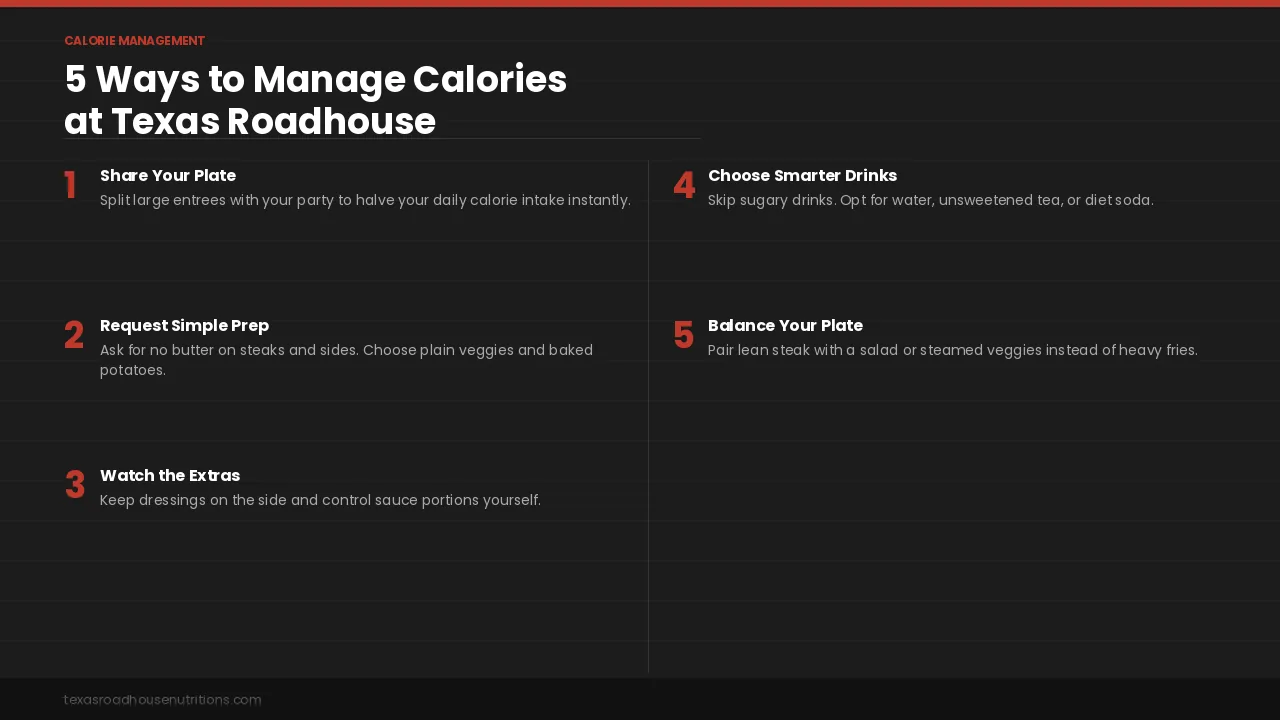
Share Your Plate: Since they serve large portions, try to share meal options or practice splitting an entree with someone in your party. This is an easy way to stay mindful of your daily calorie intake and energy intake.
Request Simple Prep: Ask for no butter on your steaks or sides. You can also request plain options for your veggies and baked potatoes to avoid unhealthy fats.
Watch the Extras: Keep dressings on the side and control sauces yourself.
Choose Smarter Drinks: Avoid sugary drinks. Instead, stick with refreshing water, unsweetened tea, or diet soda.
Balance Your Plate: Create a balance plate! Choose a high-protein meal like a lean steak to keep you satisfied and feeling full. Swap out the heavy fries for a fresh salad or steamed veggies.
Using these swaps and smart picks will help you keep your texas roadhouse calories low. You will get a highly filling meal without overindulging.
Healthy Choices at Texas Roadhouse
Eating clean is easy when you know where to look! The texas roadhouse nutrition menu makes it simple to find healthy choices that match your lifestyle. Whether you want a balanced diet, follow a special diet, or have specific health goals like weight loss, muscle gain, maintenance, or muscle recovery, they have great options.
Here are some nutrition tips and food swaps for making better choices:
Lean Proteins: Try high-protein meals that are naturally lower in fat, sodium, and carbs. A lean steak, a juicy grilled chicken breast, or a delicious grilled salmon are excellent choices.
Fresh Greens: Order a grilled chicken salad or a house salad (skip the croutons). Always ask for your dressing on the side so you can control how much you use.
Smart Sides: Choose fresh vegetables like steamed broccoli or other veggies. A sweet potato ordered plain or with minimal butter is also a great source of nutrients.
By making these smart picks and smart swaps, you can enjoy healthy, clean, and mindful eating while staying guilt-free. Our nutrition information for texas roadhouse helps you make the right dietary choices for special diets, whether you are eating vegetarian, low-carb, or looking for low calorie options at texas roadhouse (such as eating low calorie at texas roadhouse).
Lowest-Calorie Menu Options at Texas Roadhouse
If your main goal is to find the absolute low-calorie options on the menu, then we want to help you master your diet tracking and enjoy eating well without any stress.
Here is a helpful list of the best low calorie options at texas roadhouse to keep your texas roadhouse calories low:
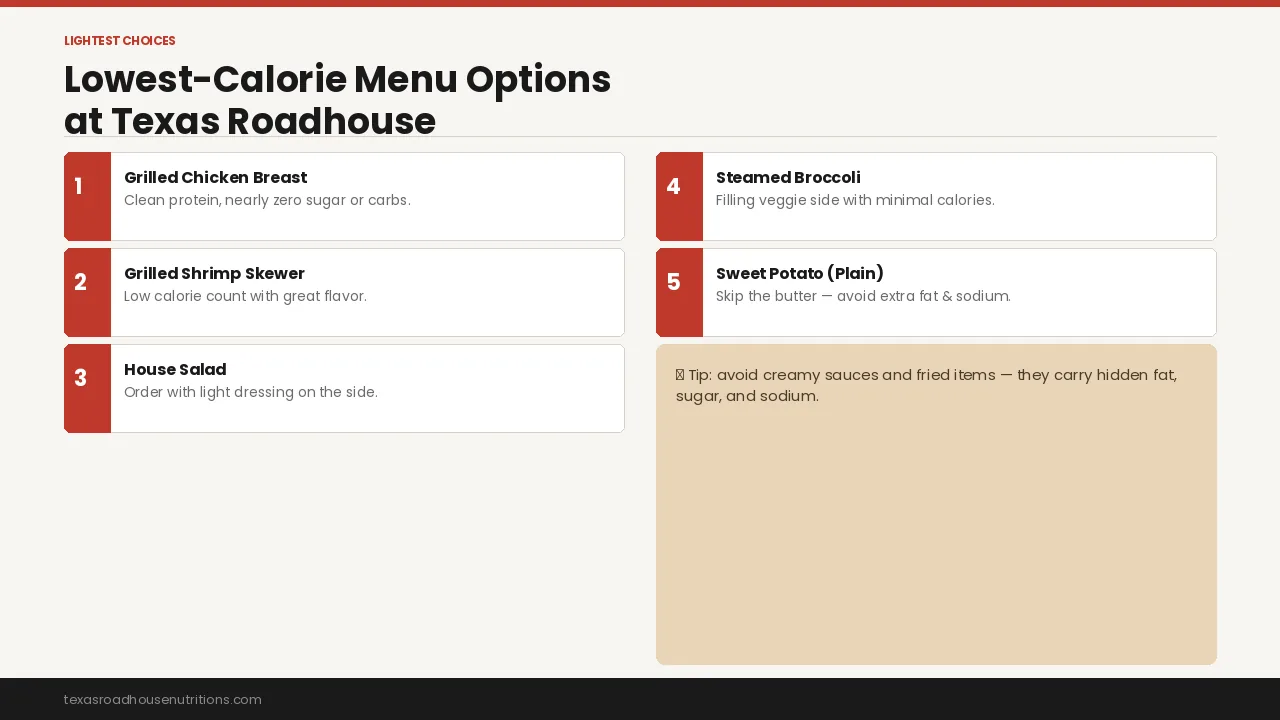
Grilled Chicken Breast: A very clean source of protein with almost zero sugar or carbohydrates.
Grilled Shrimp Skewer: Super low in calorie count and full of great flavor.
House Salad: Ask for a light dressing on the side. Avoid fried items and creamy sauces because they contain hidden sugar, hidden fat, and hidden sodium.
Steamed Broccoli: One of the healthiest sides of veggies that fills you up with minimal calories.
Sweet Potato (Plain): Order this plain with no butter to avoid unnecessary fat and sodium.
To keep your meal and food choices light, use portion control by splitting your entree or taking half of it home. Always request plain vegetables and sides to avoid added oils.
Conclusion
Making healthy choices at Texas Roadhouse is much easier when you have the right facts. Our texas roadhouse nutrition facts help you plan your next visit. Whether you want to enjoy a juicy sirloin steak, watch your daily sodium intake, or grab some buttery rolls, it gives you the numbers you need. With this nutrion facts, you can balance your plate and keep your meals clean while still enjoying your favorite comfort foods.
We hope our nutrition guide makes your next dining decision simple and guilt-free. By using simple food swaps, practicing portion control, and keeping track of your macros, you can support your personal health goals. Indeed, you do not have to give up flavor to eat well.
Take a look at our interactive nutrition menu today, find your favorite low-calorie options, and enjoy your meal with confidence!
FAQs
How can I track my Texas Roadhouse calories with the nutrition facts table?
I’ve broken down all the menu items in our table below, so you can easily pick your main cut, swap out heavy sides, and add up the numbers before you even step through their doors.
What are the 5 healthiest foods at Texas Roadhouse for weight loss?
If you’re watching your weight, my top five recommendations are the 6-ounce USDA Choice Sirloin, the Herb Crusted Chicken, the Grilled Salmon, a House Salad (without heavy dressing), and a side of Fresh Steamed Veggies.
Can I eat at Texas Roadhouse on a keto diet?
You absolutely can, just bypass the famous roll basket, steer clear of sweet BBQ sauces, and stick to their hand-cut steaks or grilled salmon paired with green beans or broccoli.
How many calories are in a steak from Texas Roadhouse?
Steak calories vary wildly based on your choice, ranging from a lean 250 calories for the 6-ounce sirloin all the way up to over 1,000 calories for the larger, marbled ribeyes.
How many calories are in Texas Roadhouse rolls?
A single fresh-baked roll has about 120 to 130 calories on its own, but once you swipe on that addictive honey cinnamon butter, you’re looking at closer to 227 calories.